
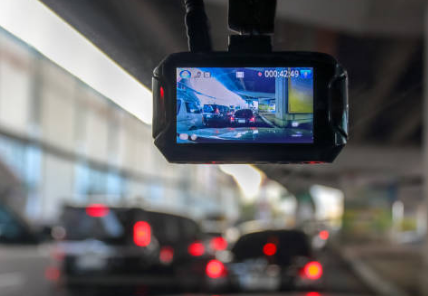
Someone backed into my parked car about two years ago and drove off. Happened at night in a parking lot. No witnesses, no cameras nearby, no way to identify who did it.
Cost me $800 in repairs and my insurance deductible. I was furious. That’s when I decided to get a dash cam.
Started researching and realized “night vision” on dash cams is mostly marketing BS. Real night vision like military equipment uses infrared. Dash cams just have decent sensors that work in low light.
But some dash cams are way better than others at recording usable footage in the dark. The difference between a cheap cam and a good one at night is massive.
Ended up getting a Viofo A129 Duo after way too much research. It’s been great for two years including capturing clear night footage a few times.
The Short Answer
Good dash cams for night recording: Viofo A129 series, BlackVue DR900X, Thinkware U1000, Garmin Dash Cam 67W.
These use Sony Starvis or similar sensors that perform well in low light. Around $150-300 depending on features.
Avoid cheap Amazon dash cams under $50. Their “night vision” is useless – just grainy dark footage that won’t capture license plates.
All dash cams record at night, but only good ones capture clear usable footage you can actually use as evidence.
I have the Viofo A129 Duo (front and rear cameras) and it’s been excellent for night recording.
What “Night Vision” Actually Means for Dash Cams
Real night vision uses infrared to see in complete darkness. Military goggles, security cameras, that kind of thing.
Dash cams don’t have real night vision. They have:
- Better image sensors (Sony Starvis is the good one)
- Wider aperture lenses (lets in more light)
- Better image processing (cleans up dark footage)
- HDR/WDR (handles bright and dark areas better)
Marketing calls this “night vision” but it’s really just good low-light performance.
The best dash cams can capture clear footage in dark conditions using street lights, headlights, and ambient light. They can’t see in pitch black.
I learned this distinction after buying a cheap cam that claimed “night vision” but produced unusable black footage at night.
My Dash Cam Journey
$30 Amazon special – First cam I bought. Decent during day, absolute garbage at night. Returned it.
Aukey DR02 – Better than the Amazon trash but night footage still pretty grainy. Used it for 6 months. Around $70.
Viofo A129 Duo – Current setup. Front and rear cameras with Sony Starvis sensors. Night footage is actually clear. $180 when I bought it.
Friend’s BlackVue DR750S – Rode in his car at night. Footage looked great on the app. More expensive at like $300.
Cheap rear cam on my old car – Added a $25 rear camera once. Couldn’t see anything at night. Total waste.
The pattern is obvious – you get what you pay for with night performance. Cheap cameras are basically useless after dark.
Sony Starvis Sensors Are The Key
This is what separates good night dash cams from garbage.
Sony Starvis sensors are designed specifically for low-light video recording. Way more sensitive than basic sensors.
Dash cams with Starvis sensors: Viofo A129/A139, BlackVue DR900X series, some Thinkware models.
These can capture license plates at night from reasonable distances. Regular sensors can’t.
My Viofo with Starvis picks up plates clearly at night from like 15-20 feet with street lights. My old Aukey couldn’t read plates at night at all.
Not all dash cams advertise whether they use Starvis sensors. You have to look at specs or reviews.
If night performance matters, make sure the cam has Sony Starvis or equivalent. Otherwise you’re wasting money.
Front vs Front+Rear Cameras
You can get just a front camera or a dual setup with rear camera too.
Front only – Cheaper, simpler. Captures what’s ahead but not behind. Around $80-150 for good ones.
Front + Rear – More expensive, more wiring. Captures everything. Around $150-300.
I got front and rear because the incident that prompted this was someone backing into me. Needed rear coverage.
If you’re mainly worried about accidents while driving, front only might be enough. For parking lot incidents, rear camera helps.
My rear camera has caught two incidents in parking lots. Worth the extra cost in my opinion.
Parking Mode Is Essential
Most incidents happen when you’re parked and not in the car. You need parking mode.
Parking mode – Camera stays on when car is off, records if it detects motion or impact.
Some cameras include parking mode, some require a hardwire kit, some don’t support it at all.
My Viofo has parking mode with a hardwire kit ($15). Wired to my fuse box so it stays powered when car is off.
It’s saved me twice – captured footage of people bumping my car in parking lots.
Without parking mode, the camera turns off when you turn off the car. Useless for parking lot incidents.
Make sure whatever dash cam you get supports parking mode and you actually set it up.
The Installation Situation
You can install dash cams yourself or pay a shop.
DIY installation:
- Mount cam to windshield (suction or adhesive)
- Run power cable to cigarette lighter or hardwire to fuse box
- Tuck cables into headliner to keep tidy
- Install rear camera if dual setup (run cable through car)
I did my front camera DIY. Took about 30 minutes. The rear camera I paid a car audio shop $50 to install because running cables through the car seemed annoying.
If you’re handy, DIY saves money. If you’re not confident, pay a shop $50-100.
Hardwire kits for parking mode require connecting to your fuse box. This is worth paying a shop if you’re not comfortable with car electrical.
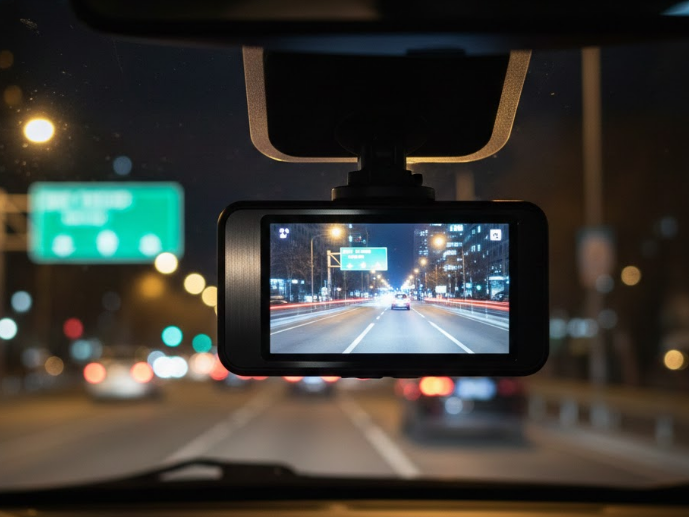
What Night Footage Actually Looks Like
Even with good cameras, night footage isn’t as clear as daytime.
Good night footage:
- Can read license plates from 15-20 feet
- Can identify car make/model
- Can see people’s general appearance
- Streetlights and headlights provide enough illumination
Bad night footage:
- Everything is dark and grainy
- Can’t read plates at any distance
- Just dark blobs moving around
- Basically useless
The difference between a $50 camera and a $200 camera at night is dramatic. The cheap one literally can’t capture usable evidence.
I’ve watched my Viofo night footage many times. It’s not HD quality but it’s clear enough to read plates and see what happened.
HDR/WDR For Night Driving
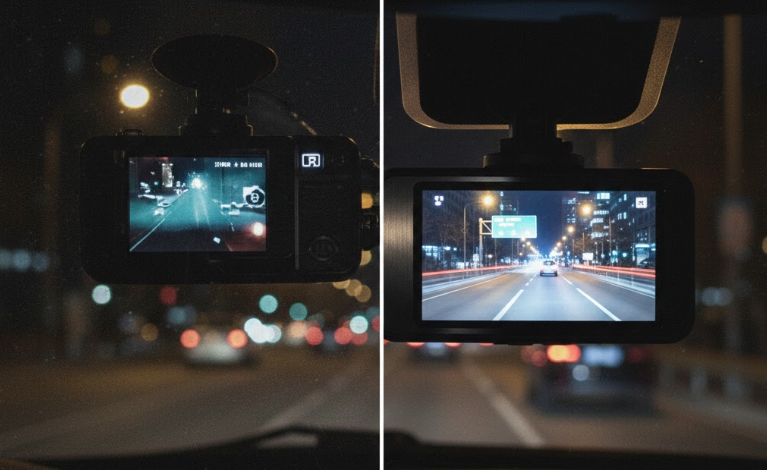
HDR (High Dynamic Range) or WDR (Wide Dynamic Range) helps with night footage when there are bright lights and dark areas.
Like when oncoming headlights are in frame. Without HDR, the bright lights blow out the image and you can’t see anything else.
With HDR, the camera balances bright and dark areas so you can see details despite bright lights.
Most good dash cams have HDR or WDR now. It’s pretty standard on anything over $100.
Makes a real difference at night when headlights and streetlights create huge brightness differences.
Resolution: 1080p vs 1440p vs 4K
Higher resolution means more detail, which helps with reading plates at night.
1080p – Minimum acceptable. Might struggle with plates at distance.
1440p – Sweet spot for most people. Good detail without huge file sizes.
4K – Best detail but creates huge files. Overkill for most people.
My Viofo is 1080p front and rear. It’s adequate but I’d go 1440p if buying today.
4K sounds great but it fills up SD cards crazy fast and many cards can’t write fast enough.
1440p is the best balance for most people if you can afford it.
Frame Rate Matters For Night
30fps vs 60fps makes a difference in how smooth the footage looks.
For dash cams, 30fps is usually fine. 60fps is smoother but not essential.
At night, higher frame rates can actually make footage darker because less light hits the sensor per frame.
Most quality dash cams do 30fps which is plenty for capturing license plates and incidents.
Don’t stress about frame rate. Focus on sensor quality instead.
GPS And Other Features
Many dash cams include GPS to track your location and speed.
This can be helpful for insurance claims or proving where an incident happened.
Mine has GPS and it’s been useful once when someone claimed I hit them in a different location than I actually did.
Other features like Wi-Fi for phone viewing are nice but not essential.
Speed cameras warnings and lane departure alerts are gimmicks I never use.
Focus on core features: good night sensor, parking mode, decent resolution. Everything else is bonus.
SD Card Requirements
Dash cams need high-endurance SD cards that can handle constant writing.
Regular SD cards fail quickly with dash cam use. You need cards rated for surveillance/endurance.
I use Samsung Endurance or SanDisk High Endurance cards. Around $15-30 depending on size.
Get at least 64GB, maybe 128GB if you want more parking mode storage.
The camera records in a loop, overwriting oldest footage. Bigger card means more history before overwriting.
Don’t cheap out on the SD card. Camera is useless if the card fails.
Brands That Actually Work
Viofo – What I use. Great performance for the price. A129 or A139 series recommended. $150-250.
BlackVue – Premium brand, excellent night performance. DR750S or DR900X series. $250-400.
Thinkware – Korean brand, good quality. U1000 has excellent night sensor. $250-350.
Garmin – Known for GPS, makes solid dash cams. Dash Cam 67W has good night mode. $200-250.
Nextbase – UK brand popular in Europe. Decent night performance. Around $150-300.
These brands consistently get good reviews for night footage. Stick with them.
Brands To Avoid
Those cheap Chinese brands on Amazon with fake reviews – APEMAN, TOGUARD, REXING (budget models), etc.
They claim night vision and amazing features for $40. They’re lying.
I wasted $30 on one before learning. Night footage was black garbage. Returned it immediately.
If it’s under $80 and claims excellent night vision, it’s probably trash.
Rear Camera Night Performance
Rear cameras often have worse night performance than front cameras because:
- Less ambient light (no headlights pointing that direction)
- Often lower quality sensor to save cost
- Farther from incidents so details are harder to capture
My Viofo rear camera is okay at night but definitely not as good as the front.
It can capture plates if a car is close behind me with their lights on. Otherwise it’s just dark footage showing car shapes.
Still useful for parking mode to see if someone backs into me. Just manage expectations.
Cloud Storage vs Local Storage
Some premium dash cams upload footage to cloud storage (BlackVue, Nextbase).
Pros: footage saved even if camera is stolen Cons: requires data plan, monthly cost, privacy concerns
Most dash cams just save to SD card locally. Fine for most people.
I don’t use cloud storage. If someone steals my camera after an incident, I’m screwed, but that seems unlikely.
Cloud storage is nice if you can afford it but not essential.
What Happened With My Parking Lot Incidents
Incident 1: Someone bumped my rear bumper in parking lot. Viofo rear cam in parking mode caught it clearly at night. Got their plate, filed claim, got paid.
Incident 2: Someone scratched my door with their car door. Parking mode caught it but it was daytime. Clear footage, got their plate, filed claim.
Both times the footage was clear enough for insurance to identify the other party. Camera paid for itself.
Without the camera I’d be out over $1000 in repairs between the two incidents.
This is why I’m religious about having a working dash cam now.
Battery Drain Concerns
Parking mode drains your car battery since the camera stays on.
Hardwire kits have low-voltage cutoff to prevent fully draining battery. Usually cuts off around 11.8-12V.
I’ve never had battery drain issues with parking mode. The cutoff protection works.
If you drive infrequently (once a week or less), parking mode might drain too much. Can disable it or add a battery pack.
For normal daily driving, battery drain isn’t an issue with proper hardwire kit.
Insurance Discounts
Some insurance companies give discounts for having a dash cam. Usually 5-15%.
Mine doesn’t but it’s worth asking yours.
Even without discount, the camera has saved me more than it cost by capturing footage for claims.
Paid $180 for the camera. Saved $800+ on repairs from incidents caught on camera. Easy math.
What I’d Buy Today
If I needed a dash cam right now I’d get Viofo A139 Duo (front and rear, 2K front, 1080p rear). Around $250.
If budget was tight I’d get the A129 Duo like I have. Still great performance for $150-180.
If money wasn’t an issue I’d consider BlackVue DR900X for cloud features and premium quality. Around $350.
Main criteria:
- Sony Starvis sensor or equivalent
- Front + rear cameras
- Parking mode support
- 1440p+ front resolution
- From reputable brand with good reviews
- Hardwire kit available
That narrows it down to a few options pretty quickly.
Installation Tips
For front camera:
- Mount behind rearview mirror so it’s not in your view
- Run cable along headliner edge, down A-pillar, to power source
- Use cable clips to keep it tidy
- Don’t block driver’s view
For rear camera:
- Mount high on rear window
- Run cable through headliner along roof
- Down rear pillar to power connection
- Test view before final mounting
For parking mode:
- Hardwire to fuse box using always-on circuit
- Set low-voltage cutoff (usually 11.8V)
- Set recording mode (motion detect or time lapse)
- Test it actually works when car is off
Or pay a shop $50-100 and skip the hassle.
Reviewing Footage
Most dash cams let you view footage on the camera screen or via phone app.
I never look at footage unless something happens. The camera just records constantly in the loop.
When I need footage I pull the SD card and view on computer, or use the phone app.
Having Wi-Fi on the camera is convenient for quick checks without removing SD card.
Make sure you know how to actually access footage when you need it. Read the manual.
The Real Answer For Most People
Buy a dash cam with Sony Starvis sensor that supports parking mode. Expect to pay $150-250 for front+rear setup.
Get it professionally installed with hardwire kit if you’re not comfortable doing electrical. Worth the $50-100.
Use a high-endurance SD card and check periodically that it’s still recording properly.
The night footage won’t be perfect but it’ll be clear enough to read plates and identify what happened.
Cheap cameras are useless at night. Spend the money for good sensor or don’t bother.
I put off getting a dash cam for years thinking they were overpriced gadgets. After needing footage multiple times, I can’t believe I drove without one.
The peace of mind knowing incidents are recorded is worth the cost. The actual footage paying for itself through insurance claims is bonus.
If you drive at night ever, getting a dash cam with good night performance is essential. Don’t rely on garbage footage from a $40 Amazon special.
Just buy a Viofo A129 or similar, get it installed properly, and forget about it. When you need the footage, you’ll be glad you spent the money on something that actually works.