
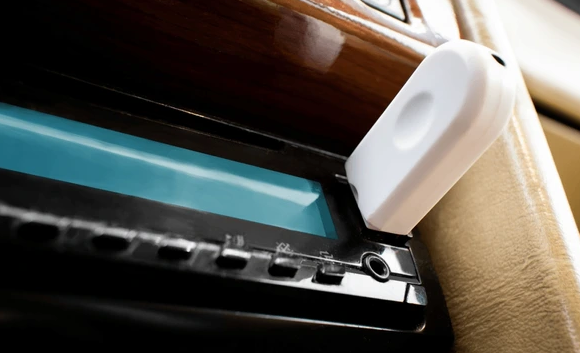
My 2009 Camry doesn’t have Bluetooth. Has a CD player and an aux port and that’s it. I was using this janky aux cable that had to be in the exact right position or one speaker would cut out. Got so annoying I’d be driving down the highway adjusting the cable angle trying to get both speakers working.
Finally decided to figure out the Bluetooth adapter situation. Went down a rabbit hole of Amazon reviews, YouTube videos, and Reddit threads. Ended up buying three different adapters over like six months before I found one that actually worked well.
Learned way more about Bluetooth audio adapters than I ever wanted to know. Let me save you the trial and error.
The Different Types That Exist
This confused me at first because there’s like four different kinds of Bluetooth adapters and they all do slightly different things.
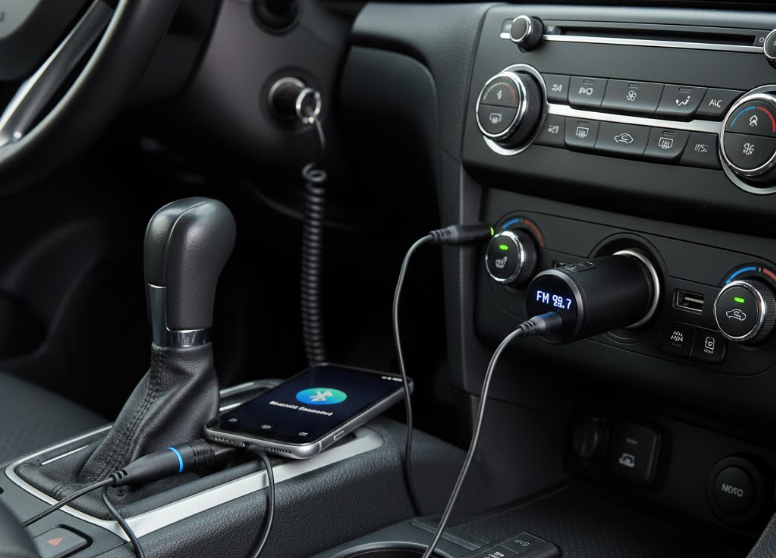
FM transmitter adapters – These plug into your cigarette lighter and broadcast over FM radio. Your car radio picks up the signal. Most common type, super cheap.
Aux port adapters – These plug into your aux jack and receive Bluetooth. Simple and direct connection.
Visor/vent clip adapters – These clip onto your visor or vent and connect via aux or FM. More convenient positioning.
USB adapters – Some cars have USB ports that can accept Bluetooth adapters. Less common but they exist.
I tried FM transmitters first because everyone said they were the easiest. Spoiler alert – they sucked for me.
My FM Transmitter Experience (It Was Bad)
Bought one of those $15 FM transmitters from Amazon with like 10,000 reviews. Plugged it into the cigarette lighter, paired my phone, tuned my radio to 88.3 like it said.
Sound quality was trash. Like listening to music through a tin can. Everything sounded compressed and tinny. Bass was nonexistent.
Also kept getting interference from actual radio stations. I’d be driving through different areas and suddenly a Spanish radio station would start bleeding through. Had to keep changing frequencies.
The USB charging port on it was nice for charging my phone. But the audio quality was so bad I couldn’t stand it. Used it for maybe three weeks before I gave up.
My coworker has one and says it works fine for him. I think it depends on where you live and how good your car’s antenna is. If you live in a city with tons of radio stations all fighting for frequencies, FM transmitters are rough.
The Aux Port Solution That Worked
Gave up on FM and bought a simple Bluetooth aux adapter. This one was like $20 and it’s just a little dongle that plugs into the aux port.
Has a built-in battery that lasts like 8-10 hours between charges. Pairs automatically when I get in the car most of the time. Sound quality is way better because it’s a direct connection.
The one I got is called the Anker Soundsync or something like that. There’s also ones from Mpow, TaoTronics, and a bunch of other brands. They’re all pretty similar honestly.
This is what I still use two years later. It’s not perfect but it’s good enough that I stopped looking for alternatives.
Sound Quality Reality Check
Here’s the thing nobody tells you – Bluetooth audio in your car is never going to sound as good as a proper wired connection or built-in Bluetooth.
Bluetooth compresses the audio. Even with fancy codecs like aptX, there’s still compression. For most people this doesn’t matter. For audiophiles it’s probably annoying.
In my car with road noise and my basic stock speakers? I honestly can’t tell the difference between Bluetooth and aux cable. Maybe if I had a fancy sound system I’d notice.
The convenience of not dealing with cables is worth way more to me than theoretical audio quality I can’t actually hear.
The Features That Actually Matter
After trying multiple adapters here’s what I learned actually matters:
Auto-connect – Some adapters pair automatically when you start your car. Others you have to manually connect every time. Auto-connect is worth paying extra for. I can’t emphasize this enough.
Battery life – For aux adapters with batteries, you want at least 8 hours. Having to charge it every other day gets old fast.
Microphone quality – If you take calls in the car, the mic matters. Cheap adapters have terrible mics and people can’t hear you. I learned this the hard way.
Controls on the adapter – Some have buttons for play/pause and volume. Nice to have but not essential if you can control from your steering wheel or phone.
Dual connection – A few can pair to two phones at once. Useful if you share a car but most people don’t need this.
USB charging port – FM transmitters usually have these. Convenient for charging your phone while you use it.
The aux adapter I use now has auto-connect and decent battery life. That’s literally all I needed. The other features are nice-to-have but those two are essential.
The Brands That Don’t Suck
I’m not trying to shill for specific brands but these are the ones that actually worked in my experience or that multiple people have vouched for:
Anker – The one I use. Solid build quality, works consistently. Around $20-25.
Mpow – Friend has one of their adapters. Says it’s been reliable for over a year. Similar price range.
TaoTronics – See these recommended a lot online. Never tried one personally but reviews are mostly positive.
Nulaxy – Popular for FM transmitters if you go that route. Better quality than the random Chinese brands.
Kinivo – Their aux adapters are well-reviewed. Slightly more expensive but supposedly last longer.
I’d avoid the super cheap $8 adapters with no brand name. I tried one and it died in three weeks. You get what you pay for.
Installation Is Stupid Easy
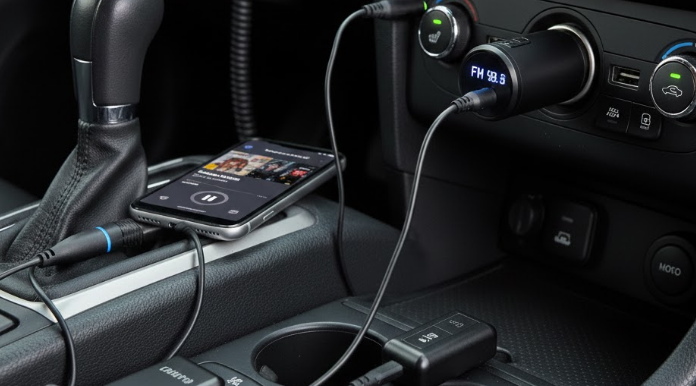
This isn’t like installing a new head unit or anything complicated. For aux adapters:
- Plug it into your aux port
- Turn on your car and set radio to aux
- Put the adapter in pairing mode (usually hold the button)
- Pair from your phone’s Bluetooth settings
- Play music
That’s it. Takes like two minutes. I’ve done it in parking lots before driving home from the store.
FM transmitters are even easier but you have to find an empty radio frequency which can be annoying in cities.
The Problems I Still Deal With
Even with a decent adapter there’s some annoying stuff:
Pairing isn’t always automatic – Sometimes I have to manually reconnect. Maybe 1 out of every 10 times I start the car. Not sure why.
Occasional audio lag – When I watch videos there’s sometimes a slight delay between video and audio. Music is fine though.
Battery needs charging – I have to charge the adapter every week or so. Not a huge deal but I forget sometimes and then it’s dead.
The cable dangles – The adapter sticks out of my aux port and the cable is always visible. Not the cleanest look. Built-in Bluetooth would be way cleaner.
Can’t use aux for anything else – Obviously if the adapter is in the aux port you can’t plug in a regular aux cable. Has to be one or the other.
None of these are dealbreakers for me. Just minor annoyances I’ve learned to live with.
When FM Transmitters Make Sense
I crapped on FM transmitters earlier but they’re actually good in certain situations:
If your car doesn’t have an aux port at all. Some older cars only have radio and CD. FM is your only option besides replacing the head unit.
If you want to charge your phone at the same time. Most FM transmitters have USB ports built in.
If you live in a rural area with fewer radio stations. Less interference means better sound quality.
If you’re okay with decent-but-not-great audio quality. For podcasts and audiobooks FM is totally fine.
My dad uses an FM transmitter in his 2005 truck and he’s happy with it. But he mostly listens to talk radio and podcasts where audio quality doesn’t matter as much.
The Fancy Adapters I Didn’t Need
There’s some expensive adapters out there with features I looked at and decided weren’t worth it:
Ones with screens – Show song info and caller ID. Cool but unnecessary. My phone already shows this.
Adapters with aptX HD codec – Better audio quality supposedly. My car speakers aren’t good enough to notice the difference.
Multi-function adapters – Play music, charge devices, have LED lights, act as a phone mount. Trying to do too many things usually means doing them all poorly.
Ones that cost $50+ – At that price you’re getting close to what it costs to just replace your head unit with one that has Bluetooth built in.
I almost bought a fancy $45 adapter with a screen and aptX. So glad I didn’t. The basic $20 one works just as well for actual music playing.
The Head Unit Replacement Question
Real talk – if you’re seriously considering spending $40+ on a Bluetooth adapter, you might want to look at just replacing your head unit.
Basic single-DIN head units with Bluetooth cost like $60-100. Installation is another $50-100 if you pay someone, or free if you do it yourself.
Then you have real Bluetooth built into your car. Better sound quality, cleaner install, more features, fits better with your car’s design.
I looked into this and decided against it because my car is old and I’m probably getting a new one in a year or two. Didn’t want to invest $150+ into a car I’m not keeping.
But if you’re keeping your car for a while, replacing the head unit might make more sense than dealing with adapters.
What I’d Buy Today
If I lost my current adapter and had to buy a new one right now, I’d probably get another Anker Soundsync. It’s worked well for two years, no reason to change.
If I didn’t have an aux port I’d reluctantly get a Nulaxy FM transmitter and deal with the sound quality compromise.
If I was feeling fancy I might try one of the higher-end aux adapters with aptX just to see if I can hear a difference. But probably not.
The main criteria would be:
- Auto-connect feature
- Good reviews about reliability
- At least 8 hour battery life
- Under $30
That narrows it down pretty quick honestly. There’s only a handful of adapters that check all those boxes.
The Quirks Different Cars Have
Worth mentioning that some cars are weird about Bluetooth adapters:
My friend’s Honda has some kind of interference issue where FM transmitters barely work at all. Something about the car’s electrical system.
Another friend has a BMW where the aux port is in the glovebox. Makes using an adapter awkward as hell.
Some cars shut off the cigarette lighter when the car is off. Seems obvious but some don’t and it can drain your adapter’s battery.
Older cars with weak electrical systems sometimes have issues powering FM transmitters properly.
Point is, what works great in my Camry might not work the same in your car. If possible, buy from somewhere with easy returns so you can test it.
My Actual Daily Experience
Two years in with my aux adapter, here’s the real day-to-day:
I get in the car. Turn it on. Adapter auto-connects 90% of the time. I press play on my phone and music starts. Takes like 5 seconds total.
Sound quality is good enough for my commute. Not amazing, not terrible. Just normal music playing.
Battery lasts a week of daily 30-minute commutes before I need to charge it. I charge it at my desk while I work.
I’ve had maybe three times where it just wouldn’t connect and I had to manually pair it again. Annoying but rare.
Once it fell out of the aux port while driving and dangled by the cable until I could pull over and plug it back in. That was my fault for not securing it better.
Overall it’s been exactly what I needed. Bluetooth in my car for cheap without major hassles. Mission accomplished.
The Bottom Line For Most People
If you have an aux port: Get a basic Bluetooth aux adapter from Anker or Mpow for $20-25. Simple, works well, good enough for normal people.
If you don’t have an aux port: Get an FM transmitter from Nulaxy or similar. Accept that sound quality will be compromised. Use it mainly for podcasts and casual listening.
If you want the best experience: Save up and replace your head unit with one that has Bluetooth built in. Will cost more upfront but way better long-term.
Don’t overthink this like I did. You don’t need the fanciest adapter with every feature. You just need something that connects reliably and plays music at acceptable quality.
I wasted money trying three different adapters when I could’ve just bought the right one first. Learn from my mistakes – get a decent mid-range aux adapter and call it done.
Unless you’re an audiophile or have weird car requirements, the $20-25 adapters work absolutely fine. That’s the real answer nobody wants to admit because it’s boring.
But boring and functional beats fancy and problematic every single time when you just want to listen to Spotify on your commute.