
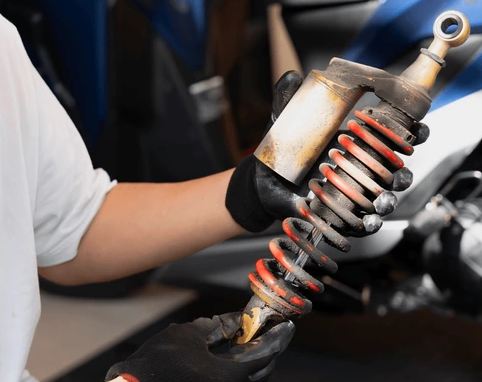
My car started bouncing like crazy going over bumps about a year ago. Felt like I was driving a boat. Every pothole sent the whole car rocking back and forth multiple times.
Took it to my mechanic thinking something was seriously wrong. He checked it out and said my shocks were completely dead. Not leaking, just worn out internally and providing zero damping.
Had 110k miles on the original shocks so I guess that’s fair. But then came the question – which shocks should I replace them with?
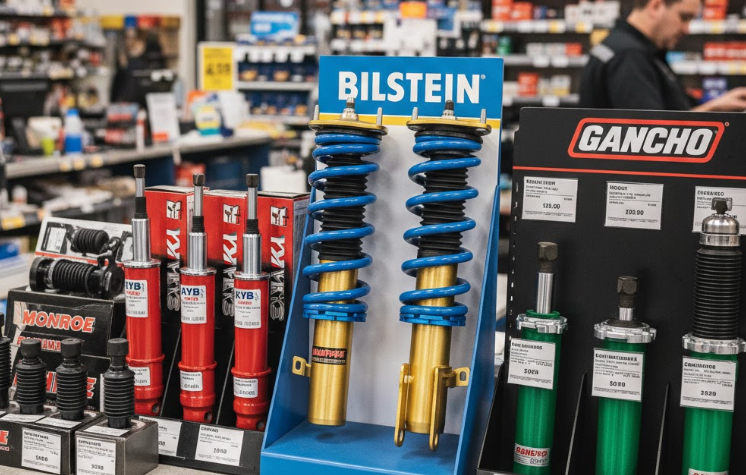
Mechanic rattled off like five brand names and different price points ranging from $60 per shock to $200+ per shock. That’s a huge spread for what seems like the same product.
Ended up going mid-range and it made a massive difference. Car rides smooth again, handles way better, doesn’t bounce. Wish I’d understood shocks better before that conversation though.
The Short Answer
For most daily drivers, Monroe, KYB, or Gabriel shocks are solid mid-range choices around $60-100 per shock.
If you want premium ride quality, Bilstein is the gold standard around $150-200+ per shock.
If you’re on a tight budget, Gabriel or AC Delco are decent at $40-60 per shock.
If you have a truck or SUV that tows or hauls, upgrade to heavy-duty shocks like Bilstein or Rancho.
I went with KYB shocks and they’ve been great for normal daily driving.
My Experience With Different Brands
KYB Gas-a-Just – What I have now. Firmer than stock but not uncomfortable. Car handles noticeably better. Around $80 per shock. Happy with them after a year.
Original equipment (OE) – Whatever came on my car from factory. Lasted 110k miles which is pretty good. No complaints until they finally died.
Monroe Sensa-Trac – Had these on my old Accord. They were fine, nothing special. Comfortable ride, handled okay. Around $60 per shock at the time.
Cheap shocks on used car – Bought a used car once that had sketchy replacement shocks. Rode terrible, felt bouncy and disconnected. Replaced immediately.
Friend’s Bilstein shocks – Rode in his car after he upgraded to Bilsteins. Noticeable improvement in handling and control. Ride was firmer but in a good way.
The pattern I noticed is that mid-range shocks from known brands work well for daily driving. Cheap shocks feel cheap. Premium shocks are noticeably better but expensive.
What Shocks Actually Do
I didn’t really understand this until I needed to replace mine.
Shocks (or struts, which are similar) control your suspension movement. Without them, your springs would just bounce endlessly after every bump.
Good shocks dampen that bouncing. Hit a bump and the car settles back down immediately instead of rocking back and forth.
They also keep your tires in contact with the road during bumps and turns. Better contact means better handling and braking.
Worn shocks let your car bounce around, reduce handling, increase stopping distance, and make the ride quality terrible.
The difference between dead shocks and new shocks is dramatic. I couldn’t believe how much better my car felt after replacing them.
The Main Brands People Actually Recommend
Asked my mechanic and did research. These brands kept coming up:
Bilstein – German brand, premium quality. Known for great handling and durability. Expensive but worth it for enthusiasts.
KYB – Japanese brand, excellent mid-range option. Good quality for reasonable price. What I went with.
Monroe – Old American brand, widely available. Solid budget to mid-range options. Very popular.
Gabriel – Another American brand, similar to Monroe. Decent budget option.
Rancho – Focused on trucks and off-road. Heavy-duty shocks for serious use.
Fox – High-end, mostly for performance and off-road applications. Expensive and probably overkill for daily driving.
AC Delco – GM’s house brand. Basic but functional for budget-conscious buyers.
These aren’t the only brands but they’re the ones mechanics trust and that have been around forever.
OEM vs Aftermarket Reality
When my shocks died the dealer wanted like $800 for OEM replacements installed. Local shop did KYB shocks for $450 installed.
The dealer acted like OEM was critical and aftermarket would ruin my car. Total BS for shocks.
Quality aftermarket shocks from KYB or Bilstein are often better than OEM. They’re engineered for the same application and frequently exceed OE specs.
Only reason to buy OEM shocks is if you’re restoring a collector car and want everything original. For normal cars, save your money.
I’ve never regretted going aftermarket on shocks. Worked perfectly and saved hundreds of dollars.
Gas vs Hydraulic Shocks
Most modern shocks are gas-charged. The gas helps prevent fade and foaming under repeated use.
Old-school hydraulic shocks were just oil. They worked but could fade with heavy use as the oil heated up and foamed.
Gas shocks stay more consistent and last longer. That’s what you want.
I’m not even sure you can buy non-gas shocks anymore for most applications. The technology has moved on.
Don’t overthink this – just get gas-charged shocks from a reputable brand and you’ll be fine.
Load-Leveling and Heavy-Duty Options
If you have a truck or SUV that carries heavy loads or tows, regular shocks might not cut it.
Heavy-duty shocks from Bilstein, Rancho, or Monroe have stronger internals and can handle weight better.
My friend tows a trailer with his F-150. He upgraded to Bilstein 5100 shocks and said it made a huge difference in how stable the truck feels while towing.
Regular shocks on a loaded vehicle will wear out faster and won’t control the suspension properly.
I have a sedan that doesn’t haul anything so regular passenger car shocks work fine. Know your use case.
Performance Shocks vs Comfort Shocks
This is a tradeoff you need to decide on.
Performance shocks (like KYB Gas-a-Just or Bilstein) are firmer. They control the suspension better, improve handling, but the ride is less cushy.
Comfort shocks (like Monroe OESpectrum or KYB Excel-G) are softer. They prioritize a smooth ride over precise handling.
I went with the firmer KYB Gas-a-Just because I wanted better handling. The ride is slightly firmer than stock but not uncomfortable.
My wife’s car has Monroe comfort-oriented shocks and rides softer but feels a bit floaty in corners.
If you drive spiritedly or care about handling, go firmer. If you just want the smoothest ride possible, go comfort-oriented.
Most people are probably fine with comfort shocks for daily driving. I’m just picky about handling.
When To Actually Replace Shocks
Most people wait way too long to replace shocks because they wear gradually and you don’t notice.
Signs it’s time:
- Bouncing more than once after hitting a bump
- Car dives forward excessively when braking
- Body roll in corners feels excessive
- Uneven tire wear (could be shocks or alignment)
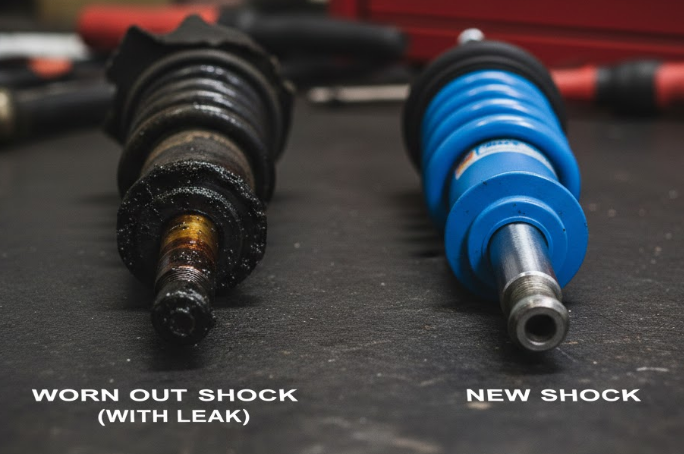
- Visible oil leaking from shock body
- Over 50-70k miles and never replaced
I drove for probably 20k miles on dying shocks because I didn’t realize how bad they’d gotten. After replacing them I couldn’t believe I’d driven that long feeling terrible.
If your car has over 50k miles and still has original shocks, seriously consider replacing them even if you think they’re fine.
The Installation Cost Reality
Shocks aren’t that expensive as parts. Labor is where it gets expensive.
Front shocks/struts often require special tools and more labor. Rear shocks are usually easier.
I paid $450 total for four KYB shocks installed. The parts were about $320, labor was $130.
If you’re handy you can install shocks yourself and save the labor. I’m not that handy so I paid.
Struts (which combine the shock and spring) are more complex to replace and cost more in labor. Sometimes requires alignment after installation too.
Get quotes from multiple shops. Price can vary a lot depending on vehicle and shop rates.
Struts vs Shocks Confusion
Many modern cars have struts in front and shocks in rear. Struts are basically shocks with the spring wrapped around them.
Struts are more expensive to replace because they’re more complex. Often $200+ each installed.
Shocks are simpler and cheaper. Usually $100-150 each installed depending on the shock quality.
My car has struts in front, shocks in rear. The fronts cost more to replace than the rears for this reason.
When someone says they need “shocks” they often mean struts too. The terms get used interchangeably even though they’re technically different.
Lifetime Warranty Shocks
Monroe and Gabriel offer lifetime warranty shocks. Sounds great but read the fine print.
The warranty covers manufacturing defects, not normal wear. Shocks wearing out at 80k miles isn’t a defect, it’s expected.
You also have to save receipts and prove regular maintenance. Most people lose these.
I don’t buy shocks based on warranty. I buy based on quality and price. Good shocks last 50-100k miles which is longer than I usually keep cars anyway.
The lifetime warranty is nice marketing but probably not worth paying extra for.
What About Adjustable Shocks
Some performance shocks are adjustable for firmness. You can dial in the exact damping you want.
Sounds cool but adds complexity and cost. Most people set them once and never adjust again.
For track cars or serious enthusiasts this makes sense. For daily driving it’s overkill.
I looked at adjustable shocks but decided I’m not going to be fiddling with settings regularly. Fixed performance shocks are fine.
Save your money unless you really want that level of control.
Brand Recommendations By Vehicle Type
Compact/midsize sedans – KYB Excel-G for comfort or Gas-a-Just for performance. Monroe OESpectrum also good. $60-100 per shock.
Sports cars – Bilstein B6 or B8. Maybe Koni if you’re really into tuning. $150-250+ per shock.
Trucks (daily driver) – Bilstein 5100 or Rancho RS5000. Around $150-200 per shock.
Trucks (off-road/heavy-duty) – Rancho RS9000 or Fox 2.0. Could be $200-400+ per shock.
SUVs – Similar to trucks, Bilstein or Rancho depending on use. $100-200 per shock.
Older cars – Gabriel or Monroe budget options fine for keeping older vehicles going. $40-80 per shock.
Match the shock to how you actually use the vehicle. Don’t overspend on performance shocks for a grocery getter.
The Coilover Alternative
Some people skip shocks entirely and go with coilovers, which are shock/spring/mount assemblies that replace your whole suspension setup.
This is more common on performance cars and lowered vehicles.
Coilovers cost way more. Like $1000-2000+ for a decent set. They’re adjustable and let you change ride height.
For normal daily driving this is complete overkill. Just get shocks.
I considered coilovers for like 30 seconds before realizing I don’t need adjustable ride height and track-worthy suspension on my Civic.
Cheap Shocks I’d Avoid
Those $30 no-name shocks on Amazon with fake reviews. Just no.
Shocks are a safety item. They affect handling and braking. Don’t cheap out with mystery brands.
I’ve seen cheap shocks fail quickly, leak oil, perform terribly. False economy.
Stick with established brands even if you’re on a budget. Gabriel is cheap but at least it’s a real brand with a track record.
What I’d Buy Today
If I needed shocks right now I’d probably get KYB Gas-a-Just again for my sedan. They’ve been great.
If I had a truck I’d get Bilstein 5100s. They’re the gold standard for truck shocks.
If money was super tight I’d get Monroe or Gabriel basic shocks. Not exciting but functional.
Main criteria:
- From a known reputable brand
- Appropriate for my vehicle and driving style
- Gas-charged (which is basically all of them now)
- Reasonable price ($60-150 per shock depending on vehicle)
- Good reviews from actual users
That narrows it down pretty quickly to KYB, Monroe, Bilstein, or Gabriel depending on budget.
The Alignment Question
After replacing struts you usually need an alignment. Shocks typically don’t require alignment.
My shop did an alignment check after installing my rear shocks and said it was fine. Cost nothing extra since they were checking anyway.
If you’re replacing front struts, budget for an alignment. Usually $80-120 depending on location.
Don’t skip the alignment on struts. Improper alignment causes uneven tire wear and poor handling.
My Current Ride Quality
Before replacing shocks: Bouncy, floaty, poor control. Felt disconnected from the road. Uncomfortable over bumps.
After KYB shocks: Firm but controlled. Car settles immediately after bumps. Much better handling in corners. Overall more confident feel.
The ride is slightly firmer than stock but I prefer it. Feels like a more solid, mature vehicle.
My wife drove the car after the new shocks and immediately noticed the difference. Way less bouncing and better control.
For $450 installed it was one of the best improvements I’ve made to the car. Should’ve done it 20k miles sooner.
How Long Different Brands Actually Last
Based on what I’ve learned from mechanics and other drivers:
Bilstein – 80-120k miles. Sometimes longer. Very durable.
KYB – 60-100k miles. Solid longevity for the price.
Monroe – 50-80k miles. Decent but not exceptional.
Gabriel – 40-70k miles. Budget pricing shows in lifespan.
OEM – 60-100k miles usually. Depends on manufacturer.
These are rough estimates. Your mileage varies based on roads, driving style, climate, etc.
I’m expecting my KYB shocks to last at least 70k miles. At that point the car will have 180k miles and I’ll probably trade it in anyway.
The Real Answer For Most Drivers
Buy KYB or Monroe shocks appropriate for your vehicle and driving style. Expect to pay $60-100 per shock for parts.
Get them installed by a shop unless you’re comfortable doing suspension work yourself.
Replace shocks every 60-80k miles or when you notice bouncing, poor handling, or other symptoms.
Don’t overthink brand choice. Any of the major brands work fine for daily driving.
The most important thing is actually replacing worn shocks instead of driving on dead ones for years like I did.
I drove my car for way too long on failing shocks because I didn’t want to spend the money. That was dumb.
The improvement in ride quality, handling, and safety was massive. Should’ve done it as soon as I noticed increased bouncing.
If your car bounces more than once after hitting a bump, your shocks are probably done. Stop reading this and go get them replaced.
It’s not an expensive repair compared to most car stuff. $400-600 for most vehicles to do all four. Worth every penny for how much better your car will drive.
Just pick a reputable brand in your budget and get it done. You’ll wonder why you waited so long once you feel how much better the car handles with fresh shocks.