
Gas prices hit like $4.50 a gallon a couple years ago and I started getting desperate about fuel economy. My Civic was averaging 32 mpg and I wanted better.
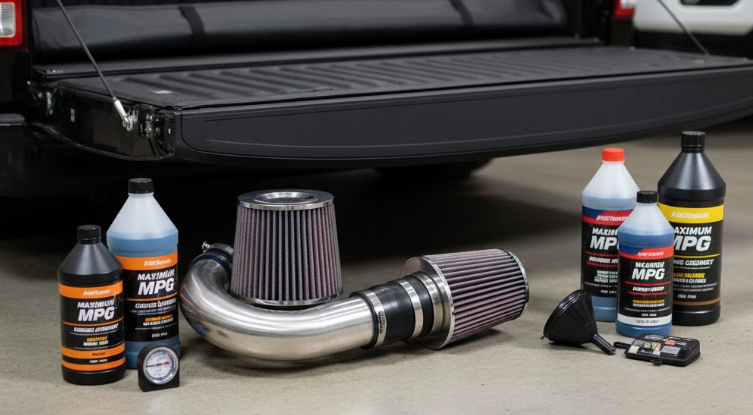
Fell down a rabbit hole of “fuel saving accessories” online. Cold air intakes promising 15% better MPG. Fuel additives claiming 20% improvement. Tonneau covers supposedly saving you 10% on trucks. Throttle controllers, aerodynamic add-ons, all kinds of stuff.
Tried a bunch of them over six months. Tracked my fuel economy obsessively with every tank. Spent probably $400 total on various accessories and gadgets.
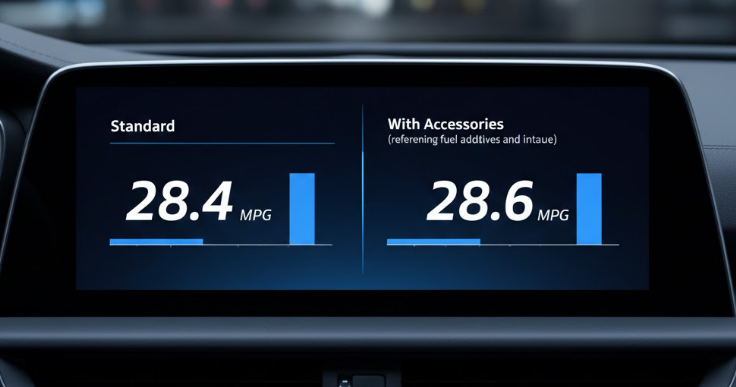
Result? My MPG went from 32 to… 32.5. Maybe. Within margin of error honestly. Basically wasted $400 learning that most fuel-saving accessories are complete BS.
The Brutal Truth Up Front
99% of fuel-saving accessories either don’t work or provide such minimal improvement you’ll never recoup the cost.
The few things that actually help are boring and unsexy: proper tire pressure, reducing weight, smooth driving habits, regular maintenance.
Everything claiming double-digit MPG improvements is lying. Physics doesn’t work that way.
Save your money. I learned this the expensive way so you don’t have to.
What I Actually Tried
Cold air intake – $280. Claims of 10-15% MPG improvement. Real result: maybe 0.2 mpg better. Basically zero.
Fuel additive – $30 for bottle that treats 10 tanks. Claims 15% improvement. Real result: literally zero difference.
Tornado vortex thing – $40. Swirls air for “better combustion.” Real result: nothing. Scam.
Throttle response controller – $150. Makes throttle more sensitive. Real result: probably worse MPG because I drove more aggressively.
Premium fuel – Tried it for a month. Car doesn’t require it. Real result: spent more on premium gas than I saved in MPG.
Aerodynamic wheel covers – $60. Real result: maybe 0.1 mpg on highway. Not worth it.
Only thing that actually helped: keeping tires inflated properly. Free. Gained like 1-2 mpg just from that.
The Cold Air Intake Scam
This is the big one people fall for. I definitely did.
Cold air intakes claim to give you more power AND better fuel economy by letting the engine breathe better.
Here’s reality: Modern cars already have well-designed intake systems. Replacing it with an aftermarket one rarely improves anything measurable.
I installed a $280 K&N cold air intake. It made a cool sound. That’s literally all it did.
Tracked MPG for 3000 miles before and after. Before: 32.1 average. After: 32.3 average. That’s within normal variation.
Plus the filter needed cleaning every 15k miles which was annoying.
Eventually removed it and went back to stock. Car ran exactly the same.
Unless you’re tuning a performance car and modifying multiple systems, cold air intakes are a waste of money for fuel economy.
Fuel Additives Are Snake Oil
These really annoy me because they’re pure marketing nonsense.
Products like Fuel Doctor, Sea Foam (for MPG claims), Techron, all claim to clean your engine and improve fuel economy.
I tried three different brands over a few months. Measured MPG carefully on every tank.
Result? Exactly zero improvement. My MPG averaged the same with or without additives.
The only thing fuel additives might help with is cleaning deposits if your engine is really gunked up. But modern gas already has detergents. You don’t need extra.
For fuel economy improvement? Complete waste of money.
Save the $30 per bottle and put it toward actual gas instead.
Tonneau Covers On Trucks
This one actually has some physics behind it but the effect is smaller than claimed.
Tonneau covers (bed covers on trucks) reduce drag by smoothing airflow over the bed.
Marketing claims: 10-15% MPG improvement!
Reality: 1-3% improvement at highway speeds. Maybe.
My friend added a tonneau cover to his F-150. We tracked MPG carefully for a month before and after.
Before: 18.5 mpg average After: 19.1 mpg average
That’s about 3% improvement. His cover cost $600.
At $4/gallon and 15k miles per year, he saves about $130 per year in gas. Takes 4.5 years to break even.
Better than most accessories but still not the miracle savings claimed in marketing.
The Myth Of Low-Rolling-Resistance Tires
Some tires are marketed as “low rolling resistance” for better fuel economy.
They do work – sort of. Maybe 1-2% improvement versus regular tires.
But they cost more and often wear faster or have less grip.
I bought Michelin Energy Saver tires specifically for MPG. They were $20 more per tire than regular Defenders.
MPG improvement? Maybe 0.5 mpg on average. Hard to even measure.
The tires wore out slightly faster too. So I paid more upfront and replaced them sooner. Net loss.
For most people, just buy good quality tires and keep them properly inflated. Don’t overpay for “fuel efficient” tires.
Aerodynamic Add-Ons
Roof racks, spoilers, ground effects, wheel covers – people buy these thinking they’ll improve aerodynamics and fuel economy.
Truth is most aftermarket aero parts are designed for looks, not efficiency.
Some things like removing roof racks you don’t use? That actually helps a tiny bit.
Adding a giant spoiler? That probably makes things worse.
I had a roof rack I never used. Removed it and gained maybe 0.3 mpg on highway trips. Free modification.
But buying aftermarket aero accessories rarely helps and often hurts fuel economy.
Weight Reduction Is Real But Limited
Removing weight from your car does improve MPG. But the effect is small.
General rule: 100 lbs removed = about 1-2% MPG improvement.
I cleaned 80 lbs of junk out of my trunk. Tools I never use, random stuff accumulated over years.
Did my MPG improve? Probably very slightly. Like 0.3-0.5 mpg maybe.
It’s free to remove junk so worth doing. But don’t expect miracles.
Some people go extreme removing spare tires and seats. That’s ridiculous for tiny MPG gains.
Clean out your trunk. Leave everything else alone.
Engine Tuners And Chips
People sell “performance chips” and ECU tuners claiming better power AND fuel economy.
This is mostly BS for stock engines.
Modern ECUs are already programmed for optimal balance of power, efficiency, and emissions. A $200 chip isn’t going to magically make it better.
I almost bought one of these before reading they don’t work on stock cars.
Only scenario where tuning helps MPG: if you’re doing engine modifications and need the tune to optimize those changes.
For stock daily driver? Save your money. The tune won’t help.
Synthetic Oil Maybe Helps?
Using synthetic oil instead of conventional might improve MPG very slightly.
The improvement is so small it’s hard to measure. Maybe 0.5% difference.
I use synthetic anyway because it’s better for the engine. But I don’t do it for fuel economy gains.
If you’re on the fence about synthetic, the tiny MPG benefit shouldn’t be the deciding factor.
The Manual Transmission Myth
People claim manual transmissions get better MPG than automatics.
This used to be true 20+ years ago. Not anymore.
Modern automatics (especially CVTs and 8+ speed autos) are often MORE efficient than manuals.
My friend insisted his manual Civic got better MPG than my automatic. We compared same model cars.
His manual: 33.5 mpg average My automatic: 34.1 mpg average
The automatic CVT was actually more efficient with normal driving.
Don’t buy a manual thinking it saves gas. That’s outdated information.
Cruise Control Actually Helps
This isn’t an accessory you buy, but using cruise control on highways does improve MPG noticeably.
Maintains steady speed instead of subconscious accelerating/decelerating.
I tested this carefully. Highway trip with cruise: 38 mpg. Same trip without cruise: 35 mpg.
That’s like 8% improvement just from steady throttle input.
If your car has cruise control, use it. If it doesn’t, maintaining steady speed manually helps too.
What Actually Improved My MPG
After $400 wasted on accessories, here’s what actually worked:
Proper tire pressure – Checking weekly and maintaining recommended PSI. Gained 1-2 mpg. FREE.
Smooth driving – Accelerating gently, coasting to stops, anticipating traffic. Gained 2-3 mpg. FREE.
Removing junk – Cleaned 80 lbs out of car. Gained 0.5 mpg. FREE.
Regular maintenance – Fresh air filter, clean oil, clean fuel filter. Gained 1 mpg. $50/year.
Using cruise control – Highway MPG improved 2-3 mpg. FREE.
Route planning – Avoiding traffic and stop-and-go. Gained 1-2 mpg. FREE.
Total improvement: Went from 32 mpg to about 37 mpg combined driving.
Total cost: $50 per year on maintenance.
That’s 15% improvement for basically free versus the claimed improvements from $400 worth of accessories that did nothing.
The Tire Pressure Lesson
This was the biggest surprise. Just keeping tires properly inflated made a real measurable difference.
Under-inflated tires increase rolling resistance significantly.
I was running 28-30 PSI when my car needs 35 PSI. Just that difference cost me 1-2 mpg.
Bought a $15 tire gauge and started checking weekly. MPG immediately improved.
This is the #1 thing people should do for fuel economy. Not buy accessories, just check tire pressure.
Driving Habits Matter Way More
The single biggest factor in my fuel economy was how I drove.
Aggressive acceleration and hard braking kills MPG. Smooth gentle inputs improve it dramatically.
I started:
- Accelerating slower from stops
- Coasting to red lights instead of braking late
- Maintaining steady highway speed
- Anticipating traffic to avoid hard braking
MPG went from 32 to 35+ just from driving style changes. Zero cost.
No accessory can match the improvement from simply driving smarter.
The Accessories That Might Actually Help
If you insist on buying accessories for MPG, these are the only ones with possible real benefits:
Tonneau cover for trucks – 1-3% improvement on highway. Expensive but at least measurable.
Tire pressure monitoring – Helps maintain optimal pressure. $30-50 for gauge or TPMS caps.
Bed covers or aero shells for trucks – Reduce drag. Small but real effect.
Removing roof racks – If you have unused racks, remove them. Free and helps slightly.
That’s basically it. Everything else is marginal at best or complete scam.
Things That Definitely Don’t Work
Fuel magnets – Claim to align molecules. Pure pseudoscience. Don’t work.
Vortex generators – Those tornado swirl things. Don’t improve combustion. Scam.
Fuel line additives – Magnets or pills you drop in tank. Snake oil.
Hydrogen generators – Claim to produce HHO gas for efficiency. Don’t work and potentially dangerous.
Performance chips for stock cars – Don’t improve MPG on unmodified engines.
Premium fuel in cars not requiring it – Waste of money. Doesn’t improve economy.
I’ve seen all of these advertised. They’re all garbage.
Testing Accessories Properly
If you want to test a fuel-saving accessory yourself:
- Track at least 5-10 tanks before installing
- Calculate average MPG carefully
- Install accessory
- Track another 5-10 tanks after
- Compare averages accounting for seasonal variation
Don’t just “feel” like MPG improved. Actually measure it.
I thought my cold air intake helped until I actually did the math. It didn’t.
Most people don’t track carefully and convince themselves accessories work based on feeling.
The Math On Accessories
Let’s say an accessory costs $200 and claims 10% MPG improvement.
My car gets 35 mpg. I drive 12k miles per year. Gas is $4/gallon.
Current fuel cost: 12000 / 35 = 343 gallons * $4 = $1372/year
With 10% improvement: 12000 / 38.5 = 312 gallons * $4 = $1248/year
Savings: $124 per year
Break-even time: $200 / $124 = 1.6 years
But that’s only if it actually delivers 10% improvement. Most don’t deliver even 2%.
At 2% real improvement: $25 saved per year. Takes 8 years to break even.
The math rarely works out in favor of buying accessories.
What I’d Tell My Past Self
Don’t waste $400 on fuel-saving accessories. Just check your damn tire pressure and stop driving like an idiot.
Replace air filter when it’s dirty. Keep up with oil changes. Remove junk from your trunk.
Those three things will get you 90% of the MPG improvement that’s actually possible.
If you really want to spend money, buy better tires when yours wear out. Not special fuel-saving tires, just quality tires you maintain properly.
Everything else is marketing BS designed to separate desperate people from their money during high gas prices.
The Real Answer
There are no magic accessories that significantly improve fuel economy.
The best ways to reduce fuel consumption are free:
- Maintain proper tire pressure
- Drive smoothly and gently
- Reduce excess weight
- Use cruise control on highways
- Plan routes to avoid traffic
- Combine trips to reduce cold starts
And basic maintenance:
- Replace air filter when dirty
- Keep up with oil changes
- Fix issues that affect performance
These will give you far more improvement than any accessory you can buy.
I wasted $400 and six months learning this. Hopefully you can skip that mistake.
High gas prices suck but don’t let desperation make you fall for fuel-saving product scams. They’re counting on that desperation to sell you garbage.
Just maintain your car properly and drive sensibly. That’s the real secret to fuel economy.