
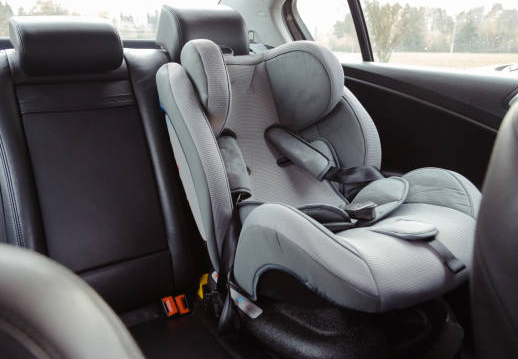
Had my first kid last year and suddenly had to become an expert on car seats. Had no idea this world even existed before becoming a parent.
Spent probably 20 hours researching car seats. Watched YouTube videos, read reviews, joined Facebook groups where parents argue passionately about which seats are safest. It’s overwhelming as hell.
Ended up buying three different seats over the course of a year because I kept learning new information and second-guessing my choices. Finally settled on something that works but man, I wish someone had just laid out the real deal from the start.
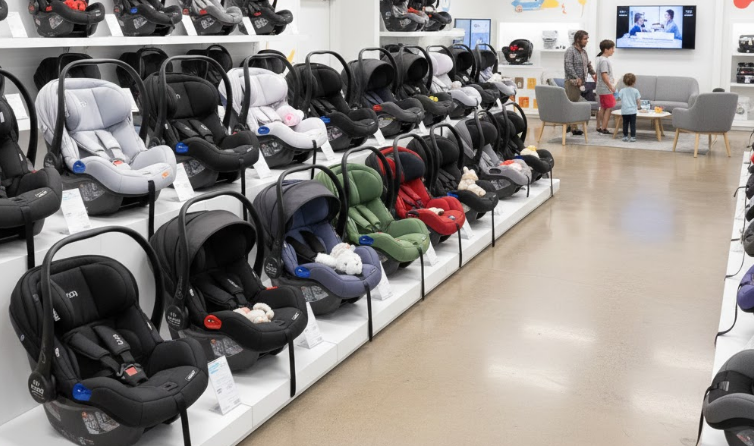
There’s No Single “Best” Seat
This drove me crazy at first. I wanted someone to just tell me “buy this one, it’s the safest.”
But car seats are like tires or brake pads – what’s best depends on your specific situation. Your car, your budget, how many kids you have, whether you’re installing it in multiple vehicles.
The seat that works great in a minivan might be impossible to install properly in a compact sedan. The one that fits three-across might not recline enough for a newborn.
I learned this when I bought a highly-rated convertible seat that literally would not fit in my wife’s Civic backseat. Couldn’t get the right angle for a newborn. Had to return it and get something else.
The Types You’ll Actually Need
Figured this out after buying the wrong seats initially:
Infant bucket seats – The ones with the handle that click into a base. Birth to about a year or when they outgrow it. Super convenient for not waking a sleeping baby.
Convertible seats – Start rear-facing for babies, flip to forward-facing for toddlers. One seat that lasts years. Less convenient but more economical.
All-in-one seats – Rear-facing to forward-facing to booster. Theoretically the only seat you’d ever need. Reality is more complicated.
Boosters – For bigger kids who’ve outgrown car seats. Usually start around 4-5 years old.
We started with an infant bucket seat because the convenience was worth it. Plan to switch to a convertible when my daughter outgrows it around a year old.
The Brands People Actually Recommend
Asked pediatrician, CPST (car seat tech), other parents, and researched online. These brands kept coming up:
Graco – Been around forever, affordable, widely available. Not fancy but they work and pass all safety standards.
Chicco – Italian brand, middle price range. Their KeyFit infant seat is like the gold standard.
Britax – More expensive, lots of safety features. Popular with safety-conscious parents.
Nuna – Luxury brand, beautiful designs, stupid expensive. Instagram mom favorite.
Evenflo – Budget option, basic but safe. Gets the job done if money’s tight.
Clek – Canadian brand, narrow seats that fit three-across. Premium price.
UPPAbaby – High-end, matches their strollers. More about aesthetics than revolutionary safety.
I ended up with a Chicco KeyFit for infant stage. It’s been great and wasn’t crazy expensive at like $200.
My Experience With Different Seats
Graco 4Ever DLX – Bought this as our first convertible seat. It was huge and wouldn’t fit properly in the Civic. Worked fine in our SUV though. Returned it.
Chicco KeyFit 30 – What we actually use now for our 6-month-old. Love it. Easy to install, clicks in/out of base smoothly, baby seems comfortable. No complaints.
Evenflo LiteMax – Friend has this budget infant seat. Works fine but feels cheaper. Straps aren’t as smooth, fabric is thinner. You get what you pay for.
Nuna Pipa – Saw this at a friend’s house. It’s beautiful and well-made but costs like $400 for an infant seat. Can’t justify that personally.
Safety 1st Grow and Go – Another friend uses this all-in-one seat. Says it’s fine but not amazing. Cheap though at like $150.
The pattern I noticed is that mid-range seats work great. Super cheap seats feel cheap but are still safe. Luxury seats are nice but not necessarily safer.
The Safety Standards Thing
Every car seat sold in the US has to pass the same federal safety standards. This was a huge relief to learn.
A $100 Evenflo seat passes the same crash tests as a $500 Nuna seat. The expensive seat might have extra features or nicer materials, but it’s not necessarily “safer.”
Where expensive seats sometimes differ is in side-impact protection, easier installation systems, or extended use limits. These are nice but not required.
I stressed so much about finding the “safest” seat before I learned they’re all legally required to meet the same standards. That changed my whole perspective.
The most important factor for safety is actually proper installation. A cheap seat installed correctly is safer than an expensive seat installed wrong.
Installation Is Where Everything Falls Apart
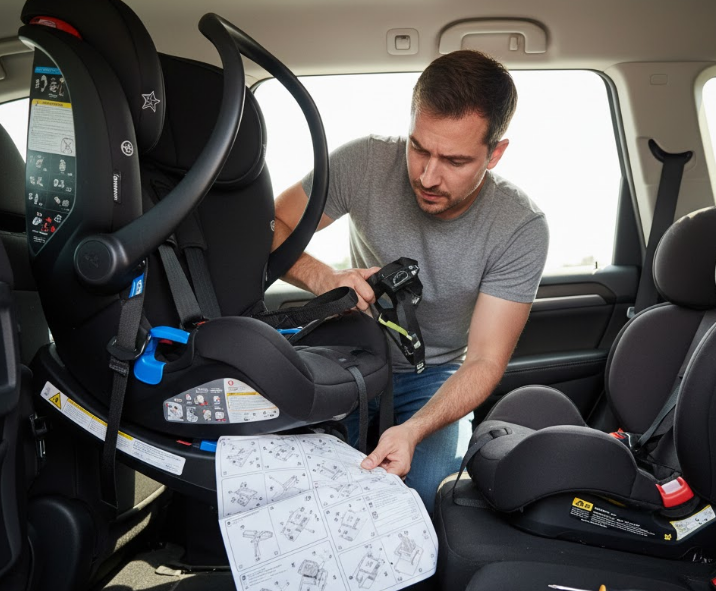
This is the thing nobody tells you – installing car seats is hard. Like really hard.
The instructions are confusing. The angles are specific. Getting it tight enough is a workout. LATCH vs seatbelt each have quirks.
I watched three YouTube videos and read the manual twice before installing our Chicco seat. Still had a CPST check it and she had to tighten it more and adjust the angle.
Something like 70% of car seats are installed incorrectly. That’s the real safety issue, not which brand you buy.
If you can, find a CPST near you and have them check your installation. Most fire stations or hospitals offer free checks. Best thing we did.
The LATCH System Confusion
Modern car seats use LATCH (Lower Anchors and Tethers for Children) to attach to the car. Sounds simple but it’s confusing in practice.
Every car has LATCH anchors at certain seating positions. Usually the two outboard rear seats. Sometimes center seat, sometimes not.
LATCH has weight limits – usually 65 pounds for the seat PLUS child. Once you exceed that you have to use seatbelt installation instead.
Our car has LATCH in the side seats but not center. This matters if you ever want to fit three seats across.
I tried installing our seat with LATCH first, couldn’t get it tight. Switched to seatbelt and got it way tighter. CPST said seatbelt is actually often more secure.
Don’t assume LATCH is automatically better. Use whichever method gets you a rock-solid installation.
The Rear-Facing Debate
Kids are supposed to stay rear-facing as long as possible now. The recommendation used to be flip them forward at 1 year. Now it’s more like 2+ years minimum, ideally longer.
Rear-facing is significantly safer in crashes. The seat catches their entire body and distributes crash forces better.
I see parents flipping their kids forward at 1 year because “their legs are scrunched” or “they want to see forward.” But broken legs heal, spinal injuries don’t.
We’re planning to keep ours rear-facing until she maxes out the rear-facing limits of whatever convertible seat we get. Probably 2.5-3 years old.
Some people get weird about this and act like keeping kids rear-facing longer is overprotective. It’s literally just following safety data.
The Infant Seat vs Convertible From Birth Debate
Some parents skip infant bucket seats and go straight to a convertible from birth. This saves money since you’re buying one less seat.
We didn’t do this for a few reasons:
Convenience – Infant seats click in/out. You can move a sleeping baby from car to stroller to house without waking them. Huge quality of life thing.
Fit – Many convertibles don’t recline enough for tiny newborns, or they’re too big and baby looks lost in them.
Multiple cars – We have two cars. Having a base in each car and moving the infant seat between them is way easier than installing/uninstalling a convertible.
That said, if money is super tight, going straight to convertible works. It’s not wrong, just less convenient.
For us the convenience was worth the extra $200 for an infant seat that we’ll use for maybe a year.
The Three-Across Problem
If you have multiple kids and a normal car, fitting three car seats across the back seat is a nightmare.
Most car seats are too wide. You need specific narrow seats like Clek Fllo or Diono Radian.
We only have one kid right now but I’ve seen friends struggle with this. They ended up having to buy a minivan just to fit three seats.
Something to think about if you’re planning multiple kids. Get narrow seats from the start or accept you might need a bigger vehicle eventually.
Features That Actually Matter vs Marketing Hype
Anti-rebound bars – These do help in rear-facing crashes. Actually useful feature.
Load legs – Similar to anti-rebound bars, adds stability. Nice to have if affordable.
Easy harness adjustment – You’ll adjust the harness constantly as baby grows. Easy systems are worth paying for.
Removable covers that are machine washable – Baby will puke/leak/spill on the seat constantly. Washable covers are essential, not optional.
Extended weight/height limits – Means the seat lasts longer before you need the next size. Saves money long-term.
Cup holders – Seem pointless but kids actually use them once they’re older. Minor convenience.
Level indicators – Help with installation. Very useful for getting the right angle.
Features I don’t care about:
- Colors and patterns (who cares, it’s covered in snacks and milk anyway)
- Matching strollers (unless you actually want the stroller system)
- Extra padding (nice but not necessary, basic padding is fine)
The Expensive Seats I Almost Bought
Nuna Rava – Gorgeous convertible seat, like $500. Almost bought it because Instagram made it look essential. Realized I was paying $300 extra for aesthetics.
UPPAbaby Mesa – Their infant seat at $400. It’s nice but the Chicco does the same thing for half the price.
Clek Foonf – Their premium convertible at like $550. It’s narrow and well-made but I can’t justify that cost.
Cybex Cloud Q – European brand, $400 infant seat that fully reclines. Sounds cool but unnecessary for our use.
I’m glad I didn’t buy these. The mid-range seats work just as well and I didn’t have to stress about my kid destroying an expensive seat with cheerios and juice boxes.
Budget Options That Work Fine
If money is tight these seats are safe and functional:
Evenflo LiteMax – Decent budget infant seat around $100. Not fancy but works.
Graco Extend2Fit – Popular convertible around $150-200. Gets the job done, nothing special.
Safety 1st Grow and Go – All-in-one for like $150. Long lifespan for the price.
Cosco Scenera Next – Super basic, super cheap (like $60), but safe and works. Good for backup car or grandparents’ car.
No shame in using budget seats. They meet the same safety standards as expensive ones.
When To Replace Car Seats
Car seats expire. Usually 6-10 years from manufacture date depending on brand.
Also replace if:
- It was in any crash, even minor
- It’s been recalled
- It’s missing parts or manuals
- The plastic is cracked or damaged
- You don’t know its history (like secondhand from stranger)
We got our seat new because buying used car seats is risky. You don’t know if it was in a crash or how it was stored.
Hand-me-downs from family/friends you trust are fine if you know the history. Random Craigslist seats are not worth the risk.
The Facebook Mom Groups Are Intense
Joined a car seat safety group on Facebook to learn. These people are seriously passionate about car seat safety.
They’ll roast you for having twisted straps. They have strong opinions about specific seats. They can identify installation problems from a single photo.
It’s intimidating but also helpful. Posted a photo of our installation and got detailed feedback on improving it.
Just be prepared for judgment if you post anything that’s not perfect. These groups mean well but can be harsh.
What I’d Buy Today
If I was starting over knowing what I know now:
For infant stage: Chicco KeyFit 30 or 35. Proven track record, easy to use, good price around $200-250.
For convertible: Graco Extend2Fit or Britax Marathon. Mid-range price, long rear-facing limits, good reviews. Around $200-300.
For all-in-one: Graco 4Ever if it fits your car. One seat from birth through booster, saves money long-term. Around $300.
On a tight budget: Cosco Scenera or Evenflo LiteMax. Basic but safe. Under $100.
For three-across: Clek Fllo. Narrow profile designed for fitting multiple seats. Around $400 but necessary if you need three across.
Main criteria:
- Fits my car properly (most important)
- Easy to install correctly
- Appropriate for child’s age/size
- Washable cover
- Mid-range price unless there’s specific reason for premium
The Real Answer For Most Parents
Get a mid-range seat from Graco, Chicco, or Britax that fits your car properly. Don’t stress about finding the absolute perfect seat.
Focus on correct installation way more than brand name. A cheap seat installed right beats an expensive seat installed wrong.
Have a CPST check your installation. It’s free and gives you peace of mind.
Keep your kid rear-facing as long as the seat allows, typically 2-3 years minimum.
Replace the seat if it expires or is in a crash.
That’s it. Don’t overthink it like I did.
I spent so much time researching the “best” seat when really any mid-range seat from a major brand would’ve been fine. The installation and proper use matter way more than choosing between brand A and brand B.
Your kid will be just as safe in a $150 Graco as a $500 Nuna if both are installed correctly. Save your money and stress for all the other expensive baby stuff you’ll need.
The most important thing is that you actually use the car seat correctly every single trip. That means:
- Straps snug enough (no slack)
- Chest clip at armpit level
- No bulky coats under the straps
- Seat installed rock-solid with less than 1 inch of movement
Get those basics right and your kid is safe regardless of which brand name is on the seat.
I wish someone had told me this before I spent weeks stressing over car seat reviews. Would’ve saved me a lot of anxiety and probably some money too.