
Cars are not just machines anymore. Cars are becoming computers on wheels. AI is being injected into almost every part of the car. Some parts are obvious. Some parts are hidden. Some parts are running even when you don’t realize it. This is the reality of modern cars. AI is no longer a feature. AI is the backbone. Without AI, many modern cars would feel dumb, blind, and unsafe.
Modern cars generate insane amounts of data every second. Cameras, radar, LiDAR, GPS, speed sensors, temperature sensors, steering input, braking pressure, engine vibration, driver behavior, passenger presence, road conditions, weather conditions, traffic density, lane markings, signboards, obstacles, voice commands, touch input, mobile connectivity—everything is being monitored, processed, and predicted. Humans can’t manually handle this volume. AI handles it. That is why manufacturers are obsessed with it.
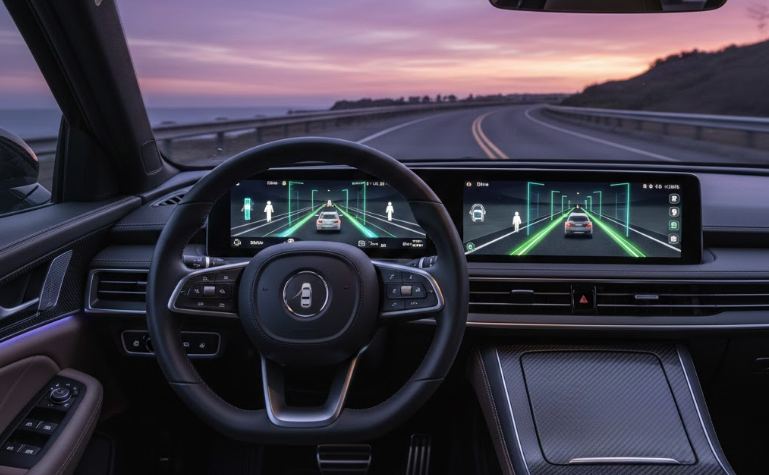
1. Self-Driving and Assisted Driving
Self-driving is the most talked-about AI use. It is not the only one, but it is the loudest one. Cars use AI to understand the road like a human would, but faster and without blinking. This includes:
- Lane detection: The car finds the lane. It stays in the lane. It corrects if the lane curves. It does this nonstop.
- Object recognition: The car identifies cars, bikes, people, animals, trees, barriers, cones, potholes, road debris. It does not get confused. It classifies them instantly.
- Decision making: The car predicts movement. If a pedestrian might cross, the car slows. If a car ahead brakes, your car reacts before you do.
- Path planning: The car calculates the safest path. It avoids obstacles. It recalculates if something moves.
Even if the car is not fully autonomous, AI-assisted driving features exist in almost all new vehicles:
- Adaptive cruise control
- Automatic emergency braking
- Traffic-aware acceleration
- Highway autopilot modes
- Parking assist
- Blind spot monitoring
These are not gimmicks. These are AI constantly trying to stop you from dying.
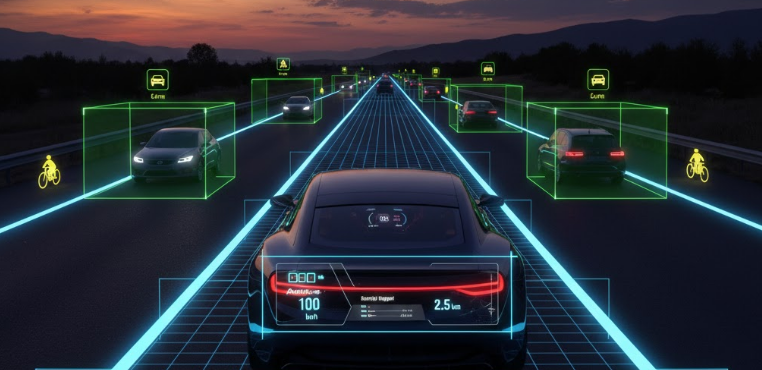
2. AI in Safety Systems
Safety is where AI shines without getting applause. Because most people don’t see it working. But it is always working.
Collision Prevention
AI calculates risks. AI decides if a crash is likely. AI brakes even if you don’t. This is lifesaving. Literally.
Driver Monitoring
Cars use internal cameras with AI to watch the driver. Not to spy, but to save idiots who drive while:
- Falling asleep
- Looking at phones
- Zoning out
- Getting distracted
AI detects your face position, eye movement, blink rate, head tilt, fatigue level, and attention span. If you are dying to sleep, the car screams at you or vibrates the seat or slows the car. The car does not care about your embarrassment. The car cares about not collecting your corpse.
Airbag Intelligence
AI decides how airbags deploy. Not every crash is the same. AI calculates speed, seat position, passenger size, impact angle, and decides how to deploy airbags without killing the passenger while trying to save them.
Traction and Stability Control
AWD, braking, wheel slip—AI analyzes grip and redistributes power or brakes individual wheels to stop skidding. This is very important on wet roads, sandy roads, and Bangladeshi roads that look like war zones.
3. AI for Comfort and Personalization
AI is not only about survival. AI also wants to make you lazy and comfortable.
Climate Control
You set 24°C. You forget about it. AI maintains it. Even if outside becomes 40°C or 10°C. AI adjusts fan speed, airflow, recirculation, seat ventilation, steering temperature, and air purification automatically. You don’t even need to think.
Voice Assistants
You talk. The car listens. The car understands. This is AI processing natural language:
- “Call mom”
- “Navigate to Dhaka”
- “Play something sad”
- “Lower brightness”
- “I’m freezing”
It is not programmed like a dumb command system. It understands context. Tone. Intent. That is AI.
Seat and Mirror Memory
AI saves your seat position. Your mirror angle. Your driving style. Your steering aggressiveness. Your braking smoothness. It builds a profile for you. This is personalization powered by AI. Not manual saving.
Noise Cancellation
Some cars use AI to generate opposite sound waves from speakers to cancel engine noise or road noise. This is the same principle used in headphones. But AI is adjusting it based on real-time noise prediction inside the cabin. This is luxury-level comfort.
4. AI in Navigation and Traffic Prediction
AI is the reason Google Maps feels smart in cars. It does not only show directions. It predicts conditions.
Traffic Forecasting
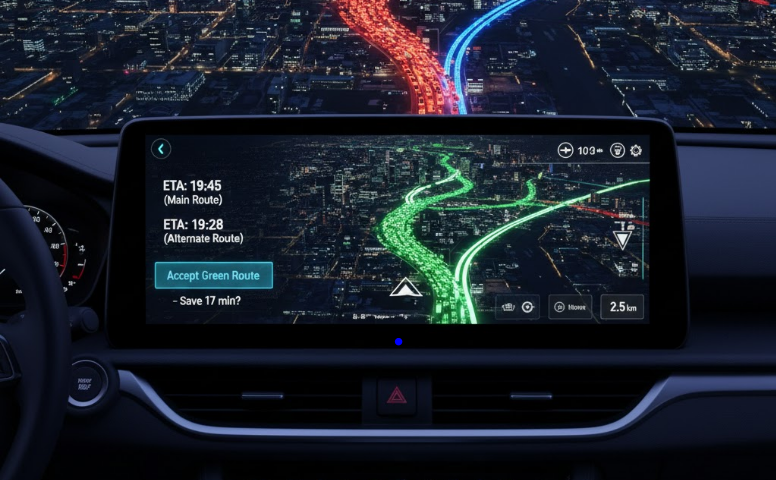
AI predicts congestion before you reach it. AI suggests alternate routes before you get stuck in traffic. It does not rely only on current traffic. It uses historical patterns. Rush hour trends. Weather. Holidays. Accidents. Construction zones. It predicts like a chess engine playing 10 moves ahead.
Real-Time Map Updates
AI updates maps using live car data from other drivers. If 1,000 cars slow at a spot, AI marks it as traffic. If cars swerve at a spot, AI flags road damage. If cars avoid an area, AI suspects obstruction. This is crowdsourced intelligence powered by AI.
Predictive ETA
AI calculates realistic arrival time, not the optimistic lie humans would calculate.
5. AI in Vehicle Health and Maintenance
This is the most underrated use case. But it is the most practical.
Predictive Maintenance
AI predicts failures before they happen. This includes:
- Battery degradation
- Tire pressure loss
- Brake pad wear
- Engine overheating
- Oil life reduction
- Alternator failure
- Transmission stress
- Suspension damage
You don’t go to the mechanic. The mechanic comes to you. Because AI warns you weeks earlier.
Driving Behavior Analysis
AI analyzes if you are abusing the car. If you accelerate like a psychopath. If you brake like you hate your tires. If you turn sharply like you are drifting a bus. AI calculates the cost of your stupidity and adjusts warnings or settings or even limits performance to protect the car.
EV Battery Optimization
In electric cars, AI controls battery charge speed, temperature, power draw, regen braking, and power distribution to maximize battery life. Without AI, EV batteries would degrade 5x faster.
Fuel Optimization
AI calculates the best engine RPM, gear ratio, fuel injection timing, and throttle sensitivity to maximize mileage. This is invisible fuel saving. But it saves more fuel than humans ever could manually.
6. AI for Parking and Surround View Systems
Parking is stressful for humans. Not for AI.
360° Camera Processing
AI stitches multiple camera feeds into a bird’s eye view. It removes distortion. It calculates distance. It adds guidelines. It identifies objects around the car. This is AI turning 4 cameras into 1 intelligent system.
Auto Parking
AI parks better than 90% of humans. Because humans panic. AI does not panic.
Reverse Assist
AI detects if you are about to reverse into something stupid like a pole or a wall or a person who decided to stand behind your car for no reason.
7. AI in Infotainment and Driving Experience
This is where AI becomes a personality.
Personalized Media Suggestions
AI suggests music based on mood. Weather. Time. Driving speed. Passenger presence. It does not choose randomly. It chooses based on patterns.
Display Optimization
AI adjusts brightness automatically. If glare hits the screen, AI darkens it. If night hits, AI dims it. If you enter a tunnel, AI recalibrates instantly.
Driver Experience Enhancement
AI adjusts:
- Steering sensitivity
- Suspension firmness
- Gear shifting behavior
- Throttle response
- Regen braking intensity (in EVs)
This is AI tuning the car to match you or the road.
8. AI for Security and Anti-Theft
Since you’re into cyber security, this part matters for you personally.
Modern cars use AI for:
- Face authentication before unlocking or starting
- Voice authentication to detect owner commands
- Behavioral analysis to detect unauthorized driving style
- Anomaly detection in key fob signal patterns to stop relay attacks
- Cyber intrusion monitoring to detect hacking attempts through OBD ports, Bluetooth, Wi-Fi, or mobile apps
Some manufacturers already use AI to detect suspicious network traffic inside the car system itself. Cars now defend against hackers like servers defend against DDoS.
9. The Future of AI in Cars
This is not the peak. This is the beginning.
In the near future, AI will:
- Predict driver intent before the driver moves
- Replace physical mirrors with AI-processed camera mirrors
- Control insurance premiums based on AI driver scoring
- Detect medical emergencies before the driver collapses
- Communicate between cars directly using AI swarm learning
- Optimize fuel and batteries in real time across millions of vehicles
- Update car software automatically using AI debugging and patching
- Replace basic dashboards with AI-generated holographic interfaces
AI will eventually make driving safer, smoother, quieter, smarter, and more efficient. But it will also expose every driver who is careless, impatient, or delusional about their driving ability.
Final Reality Check
Do sun visors help? Yes.
Do they solve everything? No.
Are they decorative? Absolutely not.
Are they enough alone? Only for direct sunlight, not reflections.
Do you still need sunglasses sometimes? Yes. If you don’t, you are gambling with your eyes.
Does angle matter? More than you think.
Does material matter? Yes. Some visors are better than others.
Does a clean windshield matter? Yes. Dirt makes glare 3x worse.
Does the sequence matter when adjusting visors? Yes. The order of adjustments matters if the sun moves.
The truth is simple: Use the visor, adjust it often, pair it with polarized sunglasses, keep the glass clean, and stop thinking one accessory solves all physics problems.