
Electric vehicles aren’t just cars with big batteries. They’re distributed power systems on wheels, full of design trade-offs that affect cost, lifespan, safety, and usability. Most buyers don’t learn these truths until after they own one — and that’s an expensive time to get educated.
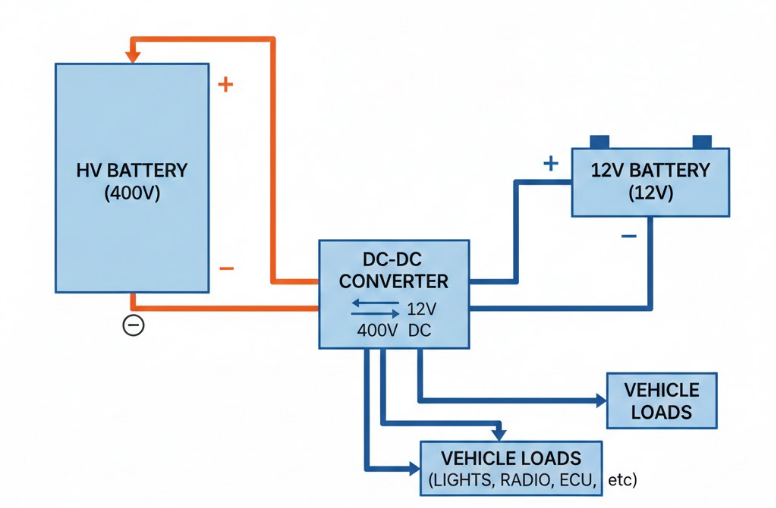
1. Your EV Runs on Two Batteries, Not One — And the Small One Fails More Often
EVs contain:
🔋 High-Voltage (HV) Battery Pack (200V–800V)
- Drives the motor
- Stores regenerative braking energy
- 30–100 kWh capacity depending on car
⚡ 12V Auxiliary Battery
- Boots the car’s computer
- Powers lights, sensors, airbags, displays, locks, security modules
Here’s the surprise:
If the 12V battery dies, the car is effectively dead. The high-voltage pack cannot “jump-start” the system because it is isolated by a DC-DC converter that needs the 12V system operational first.
Breakdown statistics from roadside assistance data repeatedly show that 12V failures are one of the top causes of non-crash EV callouts, especially when the car sits parked for long periods or in extreme temperatures.
Why it fails:
- Constant parasitic drain (telematics, alarms, keyless entry)
- More start-stop cycling than petrol cars
- Heat stress from packed electronics nearby
What to do:
- Test 12V health every 6–12 months
- Replace every 3–4 years proactively
- If storing the car long-term, disconnect or use a battery tender
2. Fast Charging Is Not Just Faster — It’s More Damaging, Even with Protection Systems
EV charging types:
| Charger Type | Power | Typical Use |
|---|---|---|
| Level 1 AC | 1.3–2.3 kW | Very slow home charging |
| Level 2 AC | 7–22 kW | Daily home/work charging |
| Level 3 DC Fast | 50–350 kW | Long trips, highways |
The physics problem:
- High current = more heat
- Heat = faster chemical aging
- Aging = permanent capacity loss
EVs use Battery Management Systems (BMS) and liquid cooling to reduce harm, but these systems limit damage, not erase it. Even when temperature is controlled, fast charging accelerates micro-structural wear inside battery cells due to:
- Lithium plating (metallic lithium deposits on the anode)
- Electrolyte oxidation
- Mechanical stress from rapid ion movement
- Thermal gradients between cell layers
Studies in lithium-ion cell longevity consistently show that frequent DC fast charging can reduce battery lifespan by 10–30% depending on frequency and environmental conditions compared to Level 2 charging.
Daily rule:
Use Level 2 for 90% of charging
Use DC fast charging only when you truly need it
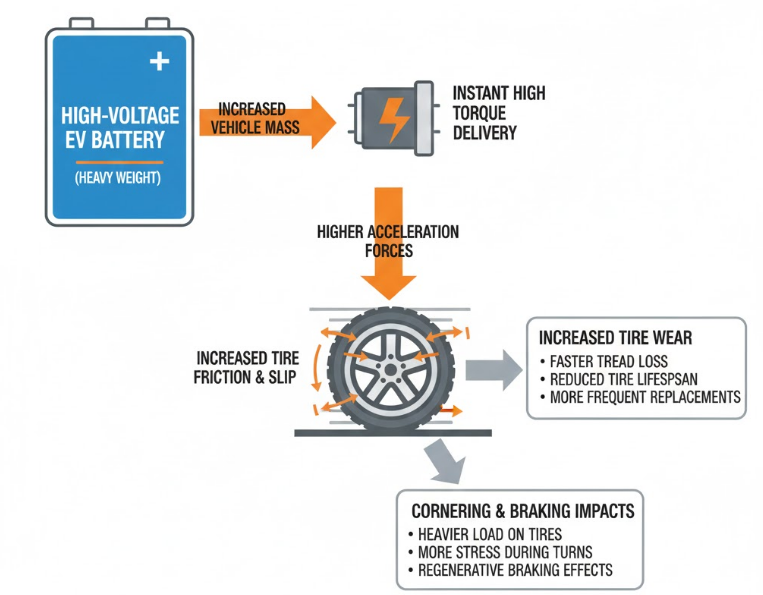
3. EVs Wear Tires Much Faster Than Engines Wear Oil — And It’s Not Just Weight
EVs are heavy, yes. But tire wear isn’t only about mass.
Additional stressors unique to EVs:
- Instant torque → higher shear forces on rubber
- Strong regen deceleration → repeated load cycling
- High curb weight + low center of gravity → different suspension geometry loads
- Quieter ride → drivers accelerate harder without realizing
- One-pedal driving habits → fewer gradual slowdowns, more sharp decel events
Real-world data from fleet EVs shows that tire replacement frequency can be 20–50% higher than petrol equivalents, especially for drivers who rely heavily on one-pedal regen and hard acceleration.
What to do:
- Maintain optimal PSI (even 3–5 PSI below target hurts range + increases wear)
- Rotate every 6,000–10,000 km
- Use tires designed for EV load ratings + low rolling resistance
- Stop pretending torque is free — your tires pay the price
4. Cold Weather Range Loss Isn’t a Bug — It’s Chemistry + Thermodynamics + HVAC Load Combined
What actually drops range in cold:
- Battery internal resistance increases
- Usable capacity shrinks temporarily
- Charging speed slows down
- Battery heater activates, consuming stored energy
- Cabin heater pulls 3–7 kW, sometimes more than the motor uses in city driving
This is why winter range drops are huge. In moderate climates the hit is smaller, but in cold regions:
- Typical range loss: 20–40%
- Charging slowdown: 30–70% slower
- Regen braking: noticeably weaker until pack warms
Bangladesh rarely sees freezing conditions, so this is more relevant for travel or import buyers than local commuters. But the principle is universal:
Your EV always spends energy to keep the battery alive, and in cold it spends a lot.
Smart habits:
- Pre-heat cabin while plugged in
- Don’t demand full power before battery warms
- Expect lower regen until temp stabilizes
5. EV Maintenance Is Cheap Because You’re Comparing It to a System That Was Designed to Fail More Often
True: EVs skip many wear-and-tear items:
- No engine oil
- No spark plugs
- No timing belts
- No fuel filters
- No exhaust components (mostly)
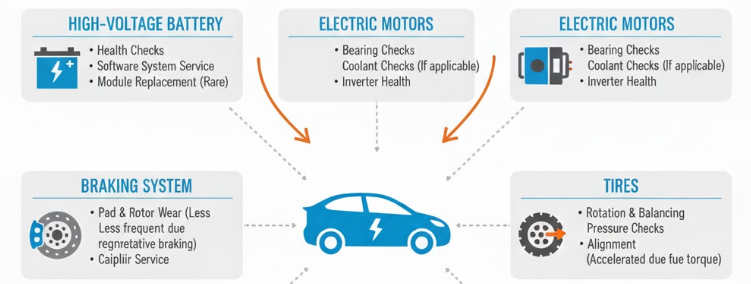
But they still contain systems that must be serviced:
| Component | Needs Service? | Interval |
|---|---|---|
| 12V battery | Yes | 3–4 years |
| Coolant loops | Yes | 4–5 years |
| Suspension | Yes | 20–30k km checks |
| Tires | Very yes | 6–24 months |
| Software/BMS calibration | Yes | Continuous |
| AC filters & seals | Yes | 12 months |
The real truth:
EVs are cheap to maintain, expensive to repair.
A hybrid battery replacement is painful.
An EV battery replacement is catastrophic financially.
So the maintenance advantage exists only if you don’t abuse the battery, tires, or cooling system.
Final Takeaways That Daily-Use Buyers Ignore
- EVs save money only if your habits don’t destroy the battery or tires
- 12V battery failure can leave you stranded even at 80% charge
- Fast charging has an opportunity cost on lifespan, even with cooling
- Regen braking shifts wear from pads → tires + suspension
- Cold hurts range because the car protects the battery by burning its own energy
- “No maintenance” is a myth. “Different maintenance” is the reality.